
Best Futures Funded Accounts
Futures funded accounts have become a popular option for traders who want access to larger capital while keeping personal financial risk limited. Instead of trading with their own funds, traders qualify through an evaluation process and trade under predefined rules set by a proprietary trading firm.
While the idea is straightforward, futures-funded programs differ significantly from forex-funded accounts in how risk is measured, how drawdowns work, and how trades are executed. Understanding these differences is essential before choosing a futures-funded evaluation.
This guide explains what makes a futures-funded account “good,” how these programs typically work, and what traders should look for when comparing futures-funded opportunities.
Because the most-favorited futures firms and best-selling futures challenges change over time, traders may want to review the current weekly or monthly best sellers, as well as the most-favorited prop firms, for an up-to-date view.
What Is a Futures Funded Account?
A futures funded account is a prop trading account that allows traders to trade exchange-traded futures contracts using firm-provided capital. Before receiving a funded account, traders must usually pass an evaluation that tests profitability and risk control.
Unlike CFD or forex funding models, futures-funded programs operate within exchange-based markets. This means contracts, tick values, and margin requirements are standardized, and trading conditions are generally more transparent.
Once funded, traders earn a percentage of the profits they generate, provided they follow the firm’s rules and stay within drawdown limits.
How Futures Funded Accounts Work
Most futures-funded programs follow a similar structure:
Evaluation Phase
Traders attempt to reach a profit target while staying within daily and overall loss limits. Contract limits and trailing drawdowns are common at this stage.
Funded Phase
After passing the evaluation, traders receive a funded account. At this point, profit targets are often removed, and the focus shifts entirely to risk management and consistency.
Payouts and Scaling
Traders become eligible for payouts based on the prop firm’s schedule. Some programs also offer scaling plans that increase the contract size or account size after consistent performance.
While the structure may sound simple, the rules in futures funding are often stricter than those found in other asset classes.
Key Features to Look for in Futures Funded Accounts
Not all futures-funded programs are built the same. When comparing options, traders should pay close attention to the following areas:
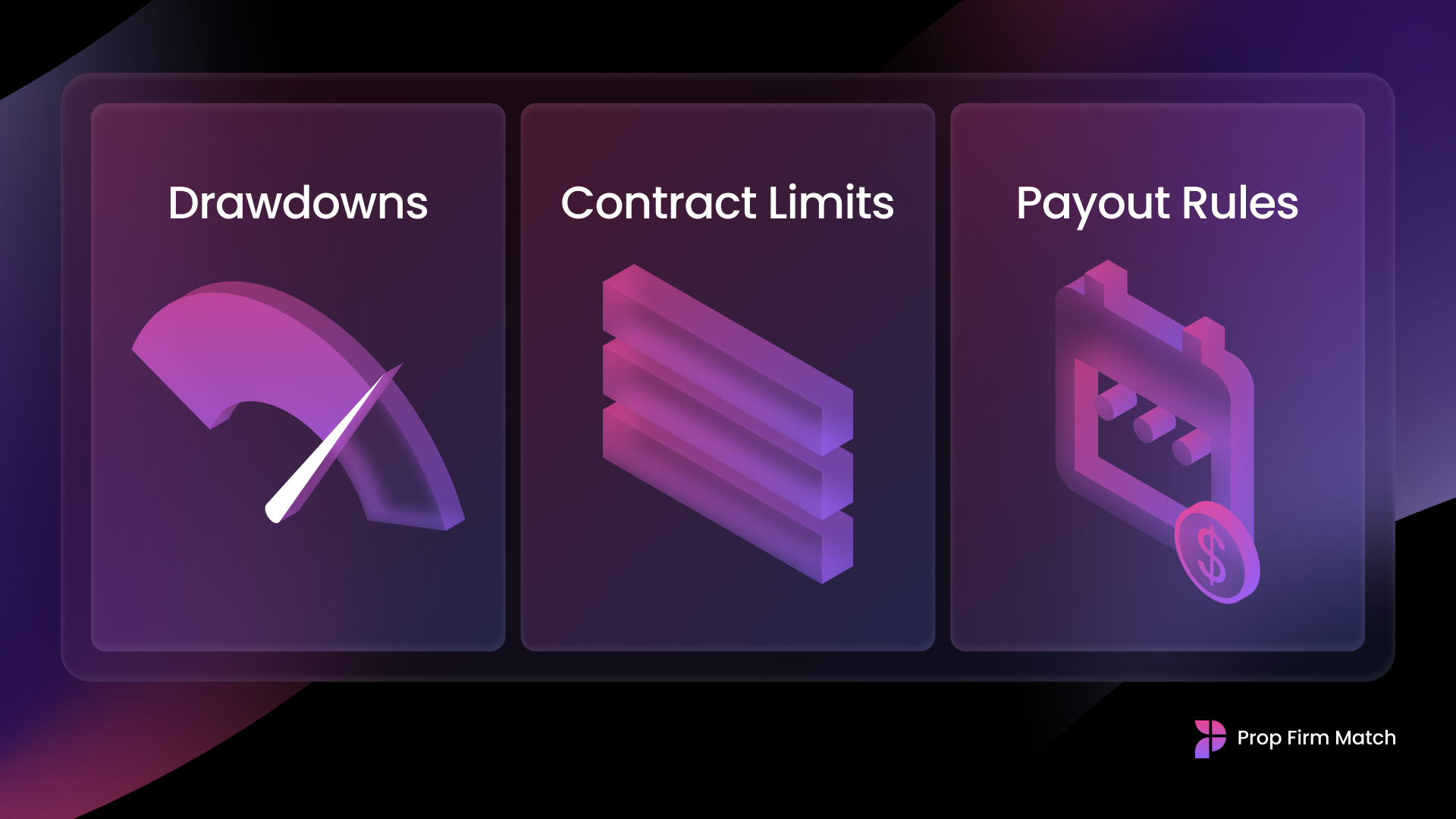
- Drawdown Structure – Trailing drawdowns behave very differently from static drawdowns and can significantly impact trading style.
- Contract Limits – Maximum contracts allowed per trade or per account affect position sizing and strategy execution.
- Evaluation Difficulty – Profit targets, time constraints, and minimum trading days vary widely.
- Payout Rules – Eligibility requirements, payout frequency, and withdrawal conditions differ by program.
Understanding how these elements interact is more important than simply looking at headline account sizes.
To compare these rules across futures prop firms, traders can explore:
→ Futures prop firm rules
Trailing vs Static Drawdowns in Futures Trading
One of the most important differences in futures-funded accounts is how drawdowns are calculated.
Trailing drawdowns move upward as profits increase, tightening risk limits as the account grows. These are common in futures funding and require traders to lock in gains early.
Static drawdowns remain fixed once the account starts. While less common in futures programs, they offer more flexibility for certain strategies.
Traders transitioning from forex-funded accounts often underestimate how restrictive trailing drawdowns can be in fast-moving futures markets.
Futures Funded Accounts vs Forex Funded Accounts
Although both models fall under prop trading, futures and forex-funded accounts operate very differently.
- Futures trading uses standardized contracts on regulated exchanges.
- Risk is measured in ticks and contracts rather than leverage ratios.
- Drawdowns are often tighter and enforced more aggressively.
- Platform choice is usually limited to futures-specific environments.
Because of these differences, traders who succeed in forex funding may still struggle when moving into futures-funded evaluations.
Risks and Limitations of Futures Funded Accounts
Futures-funded trading offers opportunity, but it also comes with constraints:
- Strict drawdown enforcement can end accounts quickly
- Contract limits may restrict strategy flexibility
- Rule violations often result in immediate account termination
- Psychological pressure increases due to tighter margins for error
These programs reward discipline and precision far more than aggressive trading.
How to Compare Futures Funded Accounts Effectively
Rather than focusing on marketing claims, traders are better served by comparing futures-funded programs based on structure and rules.
Key comparison factors include:
- Drawdown type and behavior
- Contract limits per account
- Evaluation profit targets
- Payout eligibility requirements
- Supported futures markets and platforms
Prop Firm Match allows traders to compare futures evaluations side by side, helping clarify how different programs operate before committing to an evaluation fee.
Who Futures Funded Accounts Are Best For
Futures-funded accounts are generally best suited for traders who:
- Already understand futures contract mechanics
- Trade with defined risk per position
- Can adapt to trailing drawdown constraints
- Prefer structured, rule-driven environments
They may not suit traders who rely on wide stop-losses, grid strategies, or highly discretionary approaches.
Frequently Asked Questions About Futures Funded Accounts
Are futures funded accounts real money?
Some programs use live capital, while others operate in simulated environments with real payouts. In both cases, traders receive real withdrawals as long as they meet payout conditions and follow the firm’s rules.
Why are drawdowns stricter in futures funding?
Futures markets can move quickly due to leverage and contract specifications, which increases risk exposure. To manage this, firms often use tighter or trailing drawdowns to limit losses and encourage disciplined exits.
Can beginners use futures funded accounts?
Beginners can participate, but futures funding requires a solid understanding of contracts, tick values, and margin requirements. Without this foundation, it’s easy to breach drawdown limits unintentionally. Smaller evaluations are often a safer way to gain experience while learning how futures-specific rules work.
Do futures funded accounts allow overnight holding?
This depends on the program and the specific contract being traded. Some firms allow overnight positions under defined conditions, while others restrict trading outside set hours to reduce gap and liquidity risk. Traders should always confirm session rules before placing longer-term trades.
How long does it take to get funded?
Timelines vary based on trader performance and program structure. Some traders pass evaluations in a short period by trading consistently, while others take weeks to meet profit targets without violating rules. Programs with multiple phases or trailing drawdowns may require more time and patience.
Final Thoughts
Futures funded accounts offer a structured way to trade larger capital while keeping personal financial risk limited.
They also come with tighter expectations around discipline, position sizing, and drawdown management, which traders need to understand upfront.
Before committing to a futures-funded program, it’s worth comparing evaluation rules closely, especially how drawdowns are calculated and when payouts become available.
For traders who approach these programs with realistic expectations, futures-funded accounts can serve as a practical step toward professional-style trading.
Related Articles
Keep Reading

YLOS Trading at Prop Firm Expo London 2026: What Traders Should Know
YLOS Trading puts payouts at the centre of its futures funding model, offering four plans, fast withdrawal processing, and 100% of the first $15,000 in trader profits before the standard split applies. This guide explains how the plans, drawdown models, payout rules, and news restrictions work, and what traders should ask at Prop Firm Expo London 2026.
Jun 23, 2026 • 5 min read
1
Chart Academy at Prop Firm Expo London 2026: What Attendees Should Know
Chart Academy is a pre-launch trading education platform built around free masterclasses, personalised learning paths, and trader rewards. This guide explains how the model works, what attendees should understand, and what to ask at Prop Firm Expo London 2026.
Jun 23, 2026 • 7 min read

WealthCharts at Prop Firm Expo London 2026: What Traders Should Know
WealthCharts is sponsoring the Trading Competition at Prop Firm Expo London 2026, giving traders a live way to test its multi-asset charting, scanning, AI, and prop-account tools. This guide explains what the platform offers, which prop firms support it, and what traders should ask at the Expo.
Jun 23, 2026 • 8 min read

Reviews & Rankings
News & Insights
Tools & Resources
Programs & Rewards
200 Loyalty Points Welcome Bonus.
Sign up free to claim points, unlock rewards, save favorite firms, and start earning more through reviews and platform activity.



