

Evolution of Proprietary Trading
What is Prop Trading?
Proprietary trading, also known as "prop trading," is a type of trading in which firms let skilled traders use their funds to trade. Prop firms have been around for a while and back in the day, these used to be brick-and-mortar businesses where individual traders would come in to learn.
If you have the right skills, almost anyone can join a firm these days. There are a lot of chances for people to start trading, and both new and expert traders can make money. Without them, it's tough for individual traders to get enough money to trade on the stock market. The main goal of proprietary trading firms has always been to generate profit by using different trading techniques on different financial instruments.
How Does Prop Trading Work?
Prop trading is when a bank or other financial institution trades on the market with its own capital instead of client funds in order to make money, rather than managing trades for these clients. Here's how it works:
Firm's Own Money: The firm doesn't handle its clients' investments; instead, it buys and sells stocks, bonds, and currencies with its own money.
Higher risk, higher reward: The company takes on all the risk, but it keeps all the money it makes.
Different Strategies: To make money, firms could use high-frequency trading, arbitrage, or just bet on how the market will move.
Technology and algorithms: Firms can make quick trades based on data with the help of cutting-edge technology and algorithms.
Careful Risk Management: To keep financial risk under control, companies use strict measurements like stop-loss limits and hedges.
Regulation: Proprietary trading is closely controlled in many countries to keep financial markets safe and stable.
In essence, prop trading gives firms a shot at significant profits by trading their own funds, but with higher risks, requiring careful management and regulation.
Importance of prop trading in financial markets
Proprietary trading also plays a crucial role in the financial markets. These firms contribute to market liquidity, ensure price moves smoothly, and ensure the markets are running efficiently. Oftentimes, their high-frequency trading strategies add depth to the markets, and make it easier for other participants to execute trades. They often trade a variety of asset classes and have a low-risk tolerance. But before we talk about the future, let’s take a step back into the past.
Here’s what we’ll cover:
- Historical perspective on Prop Trading
- Origins of prop trading firms
- Why staying up to date on key market trends is important
- Artificial Intelligence used in prop trading
- Current Landscape of Prop Trading
- Retail Proprietary trading firms in 2024
- The Evolution of Prop Trading: Innovations Leading the
- Way in 2024 FAQs
Historical perspective on prop trading
Proprietary trading roots go back to the early days of stock markets. Before modern regulations, it wasn't uncommon for financial institutions to trade financial instruments with their capital to profit from moves in the market. However, the concept of prop trading as a separate industry only started to take shape in the mid-20th century.
Origins of prop trading firms
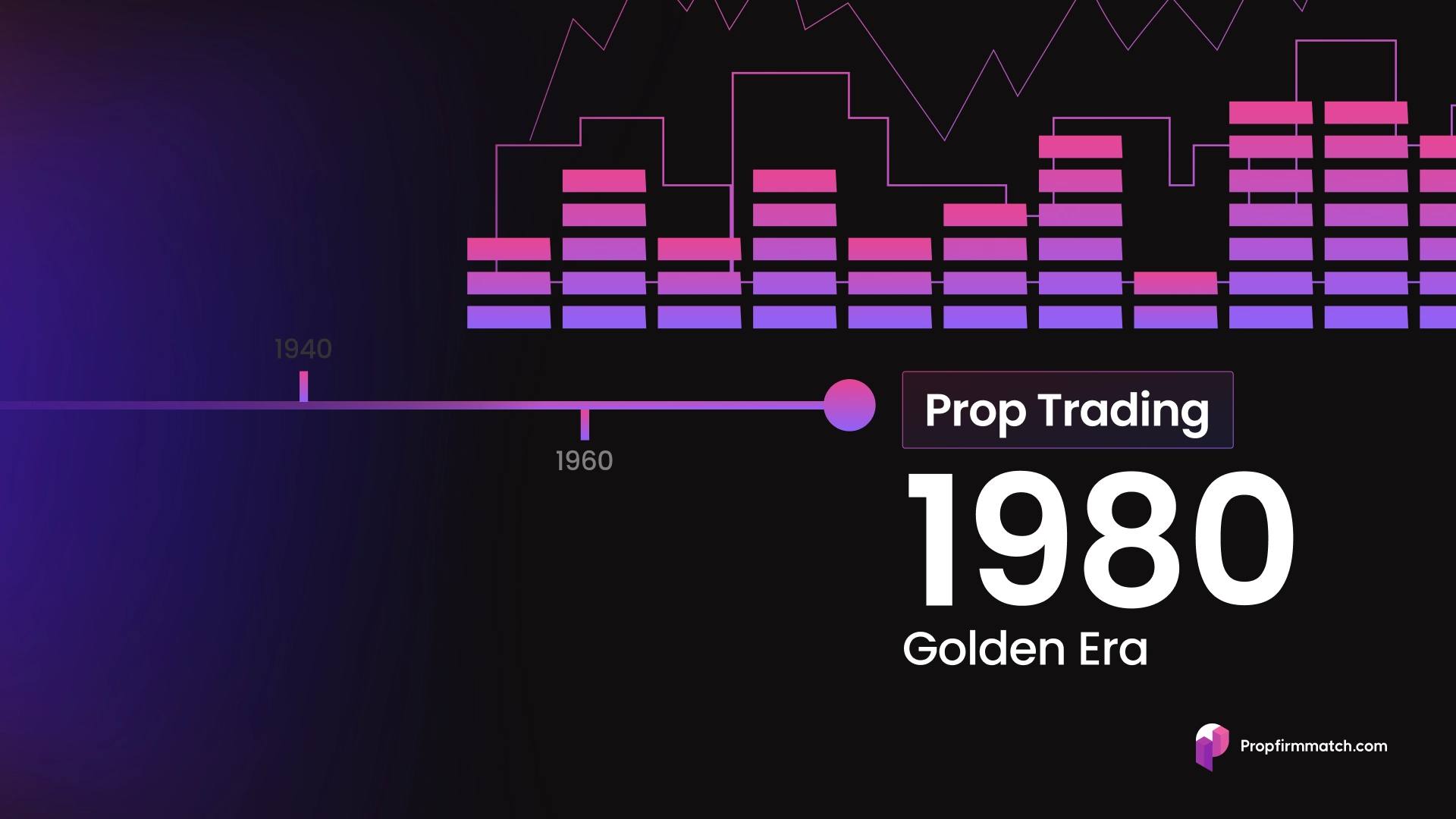
The origins of prop trading firms were in the ‘golden era’ of prop trading during the 1980s. The financial markets were becoming deregulated as the U.S. lifted the Glass-Steagall Act's restrictions. This allowed central banks and other large institutions to explore riskier activities. This era is where we first saw the rise of standalone prop trading firms inside of bigger banks and institutions. Seasoned traders set their profit targets high and leveraged the banks’ capital to take positions in many financial markets.
Evolution of prop trading strategies
There have been many changes to proprietary trade since then. In the 1990s, new technologies led to the start of electronic trading, which made markets more accessible for individual traders.
These improvements also made the markets work more efficiently as it made it possible for experienced traders to try out different trading styles and methods that were only available to the top financial institutions with the best technology before.
It was proprietary trading firms that were one of the first to use algorithms. Nowadays, algorithms and high-frequency trading (HFT) are used widespread. In the 2000s, as markets around the world became more interconnected, proprietary trading firms grew. They started to expand their presence in London, Tokyo, New York, and other big financial hubs around the world.
But after the financial crisis of 2008, institutions and investors, including private trading firms, were closely monitored and rules were changed. Laws and rules like the Dodd-Frank Act and the Volcker Rule restricted banks from making some risky or speculative investments. Prop trading firms that were not tied to banks grew quickly in the 2010s because they did not have to follow the strict rules that banks had to deal with.
What it means for financial markets
It's impossible to overstate how much proprietary trading firms have changed the financial market. They have always given liquidity and made it easier for the financial markets to work efficiently and smoothly. As they work with a wide range of financial instruments and asset types, they can help lower volatility and imbalances. But they are used to taking risks, which has gotten them a lot of bad press, especially after financial crises.
Why staying up to date on key market trends is important
Individual and expert traders alike both need to keep up with market trends in order to stay ahead. The market is always changing, so traders usually have to make changes to their strategies to keep making profit. New innovations and their democratization have leveled the playing field. Now, individual traders can get the latest information and tools that were only available to large institutions before.
Artificial Intelligence used in prop trading
Artificial intelligence (AI) and machine learning (ML) are being used more and more in both investing and proprietary trading. These cutting-edge technologies help us figure out market trends, guess how prices will move, and even set up trading methods that run themselves.
The widespread use of these technologies has given both new and experienced traders the chance to try out different trading styles and methods in order to gain a competitive edge in the market. These strategies and tools used to only be available to big banks, but now more people can use them.
Current landscape of prop trading
Role of advanced technology in prop trading
Many experienced traders are starting to integrate AI into their strategies. It’s allowing them to look at the market from a more sophisticated approach and to get insights they previously never had access to. Technology today has also made it easier than ever for the individual trader to learn to trade independently as many firms now offer educational resources to teach their traders proper techniques.
High-frequency trading in prop firms
High-frequency trading (HFT) is a trading strategy that uses cutting-edge algorithms and lightning-fast connections to quickly take traders often within milliseconds. This strategy primarily relies on proprietary tools and computer programs that have recently been advanced greatly by AI and ML. They can quickly analyze market data, detect emerging trends, and execute trades with a crystal clear focus on achieving profits. New technologies have made HFT more accessible to all, as now algorithms can trade on behalf of traders even from remote locations.
Growing presence of proprietary trading companies
The number of prop trading companies is on the rise, especially in 2024 with large increases in the number of online firms. With all of them competing against each other, they are increasing their risk tolerance and lowering the profit targets to acquire as many individual and seasoned traders as possible.
Proprietary trading firms are positioned to play an increasingly important role in the global financial ecosystem. As technology continues to advance and markets become more interconnected, firms will try to capitalize on every opportunity. Therefore they will have to navigate new and unexpected challenges in these financial markets to ensure they’re keeping their risk tolerance low and setting their profit targets high.
The democratization of trading by these online prop firms is giving the new generation of individual traders a chance to explore and thrive in an environment they previously may not have had the capital, knowledge, or risk tolerance to indulge in. To most traders who want to get funded, their only goal is to hit that profit target and get that payout.
Retail Proprietary trading firms in 2024
Key players in the industry
There are many key players across the industry but one is not better than the other.
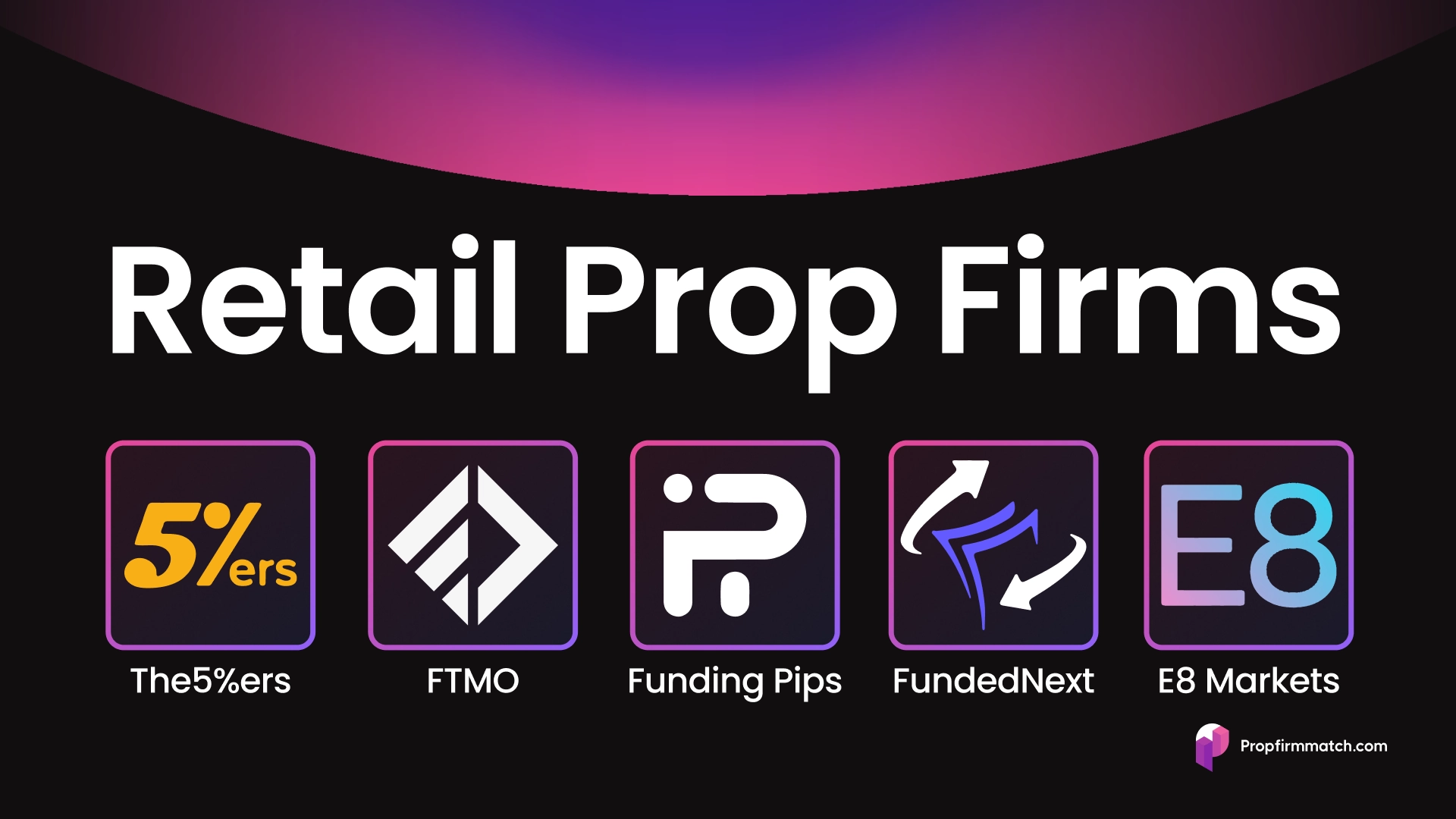
But since we know that you at least want some basis to go off of, here is a list of some prop firms along with some reasons why they are in the position that they are today:
- The5%ers
- Years of experience with a diversified offering, a firm with a proven track record, offering various types of evaluations suitable for traders
- Cutting-Edge platform features advanced technology, competitive pricing, and a user-friendly interface for seamless trading
- Community-Focused approach committed to providing value and fostering a supportive environment to enhance traders' overall experience
- FTMO
- Many years of service and high levels of trust, a well-established firm with a reputation for reliability
- Globally recognized as one of the largest and most well-known proprietary trading firms worldwide
- Attractive account options offering high account sizes with a low historical failure rate, making it a popular choice among traders
- Funding Pips
- Comprehensive trading tools also offer a wide variety of trading tools across multiple platforms
- Innovative platform provides structured programs tailored for traders' needs
- Large supportive community and offers educational resources as well as psychological support for traders
- FundedNext
- Offers a variety of evaluations and account sizes, along with premium trading tools
- Designed to work seamlessly with the popular MetaTrader 4 (MT4) and MetaTrader 5 (MT5) platforms
- E8 Markets
- Offers some of the highest profit splits in the industry, with a wide range of account sizes customizable with add-ons
- Unique social features providing fast and efficient support along with distinctive social elements
- Strong community engagement, Offers robust tools to promote community interaction and support
The Evolution of Prop Trading: Innovations Leading the Way in 2024 FAQs
- What is the best prop firm for 2024?
There is no clear best. Based on longevity and TrustPilot ratings, FTMO ranks consistently near the top.
- What is the difference between market making and prop trading?
Prop trading firms look for traders to trade their money privately. Market making is a way for big institutions to have a big influence on the price of an asset. Market making is something that some prop firms might do, but not all of them do.
- What's the difference between hedge funds and prop trading?
Both proprietary trading firms and hedge funds want to generate profit, but their capital comes from different places. Because proprietary trading firms use their own money, they can take on more risk with fewer rules to follow. Hedge funds get their money from outside investors, who expect them to be less risky and follow stricter rules.
- What are some strategies in prop trading?
An individual trader can use a lot of different trading techniques. One example that is becoming more popular is high-frequency trading (HFT). This is because new technology makes it easier for dealers to use. There are, however, many strategies that work besides HFT. It all comes down to finding your own edge in the market.
Related Articles:
Keep Reading

YLOS Trading at Prop Firm Expo London 2026: What Traders Should Know
YLOS Trading puts payouts at the centre of its futures funding model, offering four plans, fast withdrawal processing, and 100% of the first $15,000 in trader profits before the standard split applies. This guide explains how the plans, drawdown models, payout rules, and news restrictions work, and what traders should ask at Prop Firm Expo London 2026.
Jun 23, 2026 • 5 min read
1
Chart Academy at Prop Firm Expo London 2026: What Attendees Should Know
Chart Academy is a pre-launch trading education platform built around free masterclasses, personalised learning paths, and trader rewards. This guide explains how the model works, what attendees should understand, and what to ask at Prop Firm Expo London 2026.
Jun 23, 2026 • 7 min read

WealthCharts at Prop Firm Expo London 2026: What Traders Should Know
WealthCharts is sponsoring the Trading Competition at Prop Firm Expo London 2026, giving traders a live way to test its multi-asset charting, scanning, AI, and prop-account tools. This guide explains what the platform offers, which prop firms support it, and what traders should ask at the Expo.
Jun 23, 2026 • 8 min read

Reviews & Rankings
News & Insights
Tools & Resources
Programs & Rewards
200 Loyalty Points Welcome Bonus.
Sign up free to claim points, unlock rewards, save favorite firms, and start earning more through reviews and platform activity.



