
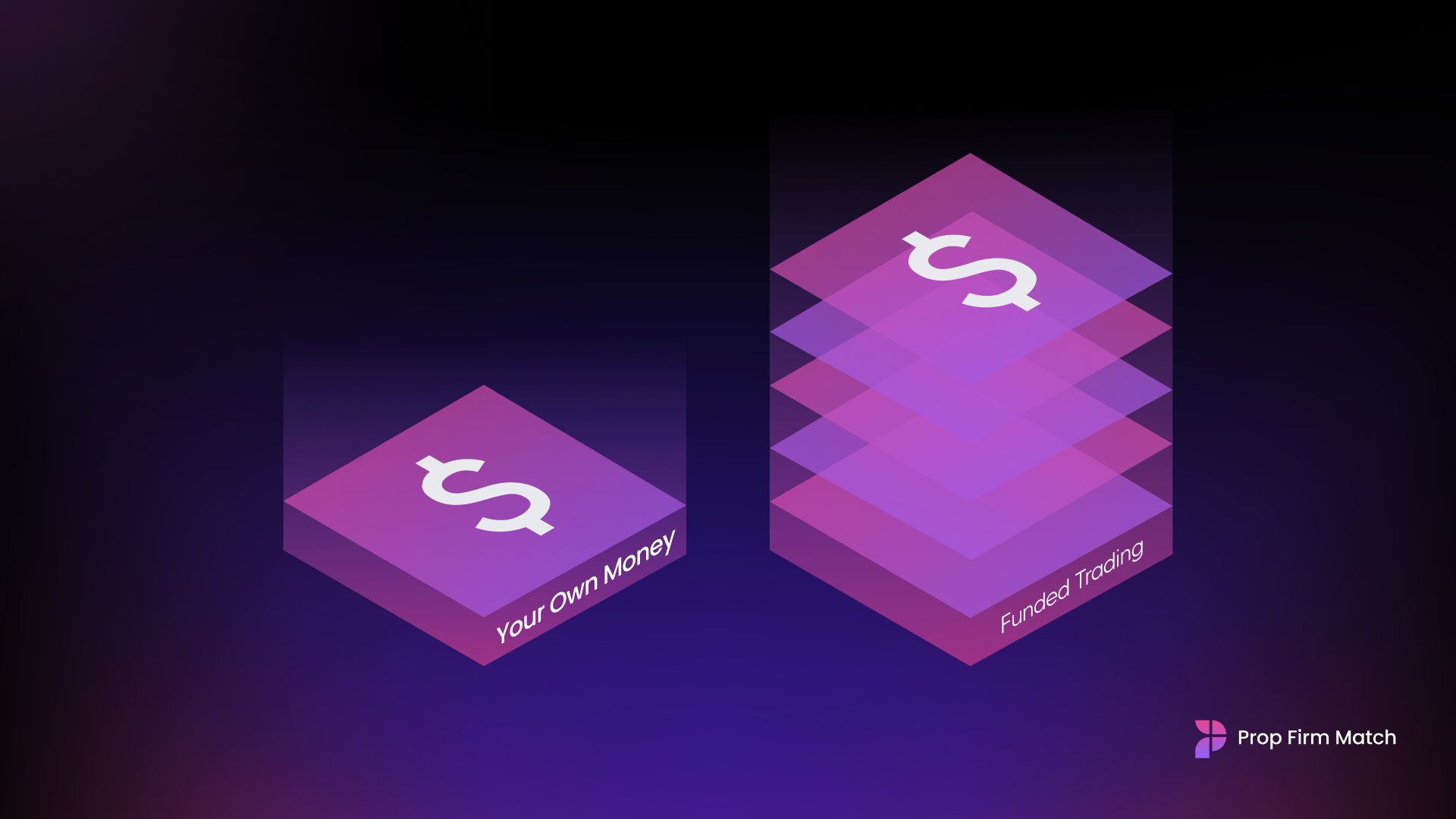
Funded Trading vs Trading Your Own Money: Which Is Right for You?
Choosing between funded trading and trading your own money is a key decision for any trader. Both approaches can be profitable, but they differ in how capital is accessed, how risk is handled, and how growth develops over time.
With funded trading, traders access capital from a prop firm after passing an evaluation. Trading your own money means using personal funds in a brokerage account, with full responsibility for every decision and outcome.
Understanding these differences makes it easier to choose the approach that fits your skills, mindset, and long-term goals. This guide compares funded trading and personal trading across capital, risk, psychology, costs, and scalability.
What Is Funded Trading?
Funded trading is a model where traders operate using capital provided by a prop firm. Instead of depositing their own money, traders pay an evaluation fee and must show consistent performance while following predefined risk rules.
Once funded, traders earn a percentage of the profits. Trading losses are absorbed by the firm, as long as drawdown limits are respected.
These limits exist to protect firm capital and encourage disciplined trading behavior. As a result, most funded trading programs focus on identifying traders who manage risk consistently, rather than those chasing short-term gains.
→Learn more: What is a funded trading account?
What Does Trading Your Own Money Mean?
Trading your own money means using personal capital in a brokerage account. Traders have full control over position sizing, strategy selection, and trade management, and they keep 100% of the profits they generate.
However, all losses are absorbed directly by the trader. There are no external drawdown limits, resets, or capital buffers. Capital preservation and risk management are entirely the trader’s responsibility.
This approach is often preferred by traders who value flexibility and long-term independence over faster access to large capital.
Capital Access and Risk Exposure
Capital access is one of the biggest differences between funded trading and personal trading.
With funded trading, traders can access significantly larger account sizes while risking only the evaluation fee. Losses are capped by daily and overall drawdown limits set by the firm.
When trading personal capital, account size is limited by available savings. Every loss directly reduces the trader’s balance, and large drawdowns can have lasting financial consequences.
For traders with strong strategies but limited capital, funded trading offers a way to reduce personal financial risk while gaining exposure to larger positions.
Rules, Restrictions, and Flexibility
Funded trading programs operate under strict rules designed to protect firm capital. These rules often include:
- Daily and overall drawdown limits
- Restrictions on trading during news or overnight
- Limits on position sizing or leverage
- Prohibited strategies
Trading personal capital offers complete flexibility. Traders can adjust risk freely, change strategies, and trade during any market condition without external constraints.
This difference in structure is often the deciding factor in whether a trader performs better in a funded or personal trading environment.
Profit Potential and Profit Retention
| Aspect | Funded Trading | Trading Your Own Money |
|---|---|---|
| Capital Size | Large | Limited by savings |
| Profit Share | Shared with firm | 100% retained |
| Scaling Potential | High | Slow and organic |
| Long-Term Growth | Faster with discipline | Depends on reinvestment |
Funded traders may keep a smaller percentage of profits, but they benefit from managing larger capital earlier. Personal traders retain all profits, but growth depends entirely on reinvestment and account size.
Psychological Differences
Funded trading isn’t stress-free. Trading under firm rules, knowing an account can be terminated for mistakes, creates a different kind of pressure than most retail traders are used to.
With personal trading, the pressure comes from a different place. Losing your own money can trigger hesitation, emotional reactions, or even revenge trading after a drawdown.
In the end, understanding how you personally handle stress, losses, and constraints is just as important as choosing the right trading model.
Costs and Financial Commitment
Funded trading involves upfront costs such as evaluation fees and, in some cases, reset fees. While these costs are small compared to the capital provided, they can add up if traders repeatedly fail challenges.
Trading personal capital does not involve program fees, but it requires sufficient starting capital and the ability to withstand drawdowns without external protection.
Scalability and Long-Term Growth
Most funded trading programs include scaling plans that increase account size after consistent performance. This allows traders to grow capital without increasing personal financial exposure.
Personal traders must scale accounts through reinvestment, which is slower but provides full ownership and independence.
For many traders, the speed of scaling is one of the strongest advantages of funded trading.
Case Study: Two Traders, Two Different Paths
Trader A joins a funded trading program with limited personal capital. After passing the evaluation through disciplined risk management, the trader receives a funded account and begins withdrawing profits. Over time, consistent performance allows the account to scale to a larger allocation.
Trader B trades personal capital with full flexibility. Profits are fully retained, but losses directly reduce the account balance. Growth is slower, but the trader maintains complete control and independence.
This is a simplified example meant to illustrate the differences rather than guarantee outcomes. Both traders can succeed, but their risk exposure, pressure, and growth timelines differ significantly.
Who Should Choose Funded Trading?
Funded trading may be a good fit for traders who:
- Have consistent strategies
- Respect strict risk rules
- Want access to larger capital
- Prefer limited personal downside risk
Who Should Trade Their Own Money?
Trading personal capital may suit traders who:
- Value full flexibility
- Use experimental or high-risk strategies
- Have sufficient starting capital
- Aim for long-term independence
Which Option Is Right for You?
Neither funded trading nor personal trading is universally better. The right choice depends on experience level, capital availability, psychological profile, and long-term goals.
Many traders use funded trading as a stepping stone before transitioning to personal capital or combining both approaches.
Frequently Asked Questions: Funded Trading vs Trading Your Own Money
Is funded trading safer than trading your own money?
Funded trading limits personal financial risk because traders are not using their own capital beyond evaluation or reset fees. Losses are capped by firm-defined drawdown rules.
Trading your own money involves higher financial exposure, as all losses directly reduce personal capital, but it offers complete control.
Can traders switch from funded trading to trading their own money?
Yes. Many traders use funded trading as a stepping stone to build discipline, experience, and confidence before transitioning to personal trading accounts.
Others continue using both models in parallel, depending on their goals and risk tolerance.
Do funded traders actually receive real payouts?
Yes, as long as the trader follows the firm’s rules and meets payout conditions.
Some firms use live capital, while others use simulated accounts with real payouts, but in both cases, withdrawals are paid in real money.
Why do some traders prefer trading their own capital?
Trading personal capital offers full flexibility. Traders are not subject to profit splits, drawdown rules, or trading restrictions set by a firm.
This approach often appeals to experienced traders with sufficient capital and strong self-managed risk control.
Is funded trading suitable for beginners?
Funded trading can be suitable for beginners who are willing to trade conservatively and respect strict risk rules.
Smaller evaluations are usually a better starting point, as funded accounts still require consistency and emotional discipline.
Can traders make more money trading their own capital?
Potentially, yes — personal traders keep 100% of profits. However, growth is often slower due to limited starting capital.
Funded traders may earn a smaller percentage per trade but can manage larger capital earlier in their trading journey.
Which option is better for long-term growth?
There is no single best option. Funded trading offers faster scaling with limited personal risk, while trading your own money provides independence and full profit ownership.
Long-term success depends on choosing the model that aligns with your strategy, psychology, and financial goals.
Where to Go Next
If funded trading aligns with your goals, the next step is understanding how programs differ and comparing them carefully.
Prop Firm Match helps traders compare prop firm challenges and evaluations side by side, including rules, pricing, payout structures, and verified trader reviews, so you can make informed decisions before paying any evaluation fees.
From here, you can explore:
- Prop firm challenges and evaluations based on verified trader reviews
- Challenges by asset class, including forex and futures evaluations
- Evaluation rules, such as profit targets, drawdown limits, and payout structures across firms
→ Compare prop firm challenges and evaluations on PropFirmMatch
Related Articles
Keep Reading

YLOS Trading at Prop Firm Expo London 2026: What Traders Should Know
YLOS Trading puts payouts at the centre of its futures funding model, offering four plans, fast withdrawal processing, and 100% of the first $15,000 in trader profits before the standard split applies. This guide explains how the plans, drawdown models, payout rules, and news restrictions work, and what traders should ask at Prop Firm Expo London 2026.
Jun 23, 2026 • 5 min read
1
Chart Academy at Prop Firm Expo London 2026: What Attendees Should Know
Chart Academy is a pre-launch trading education platform built around free masterclasses, personalised learning paths, and trader rewards. This guide explains how the model works, what attendees should understand, and what to ask at Prop Firm Expo London 2026.
Jun 23, 2026 • 7 min read

WealthCharts at Prop Firm Expo London 2026: What Traders Should Know
WealthCharts is sponsoring the Trading Competition at Prop Firm Expo London 2026, giving traders a live way to test its multi-asset charting, scanning, AI, and prop-account tools. This guide explains what the platform offers, which prop firms support it, and what traders should ask at the Expo.
Jun 23, 2026 • 8 min read

Reviews & Rankings
News & Insights
Tools & Resources
Programs & Rewards
200 Loyalty Points Welcome Bonus.
Sign up free to claim points, unlock rewards, save favorite firms, and start earning more through reviews and platform activity.



