How Do Funded Trader Accounts Work? A Step-by-Step Explanation
Funded trader accounts follow a structured process that allows traders to access significant trading capital without risking their own money. Instead of depositing funds upfront, traders must first demonstrate skill and discipline under predefined rules set by a prop firm.
While the concept may sound straightforward, many traders struggle because they do not fully understand how funded trader accounts work. This guide explains each step of the funded trading model, what firms expect from traders, and where most mistakes occur.
If you are considering joining a funded trading program, understanding this process is essential before choosing a firm or paying any evaluation fees.
The Funded Trader Account Model Explained
At its core, a funded trader account is a performance-based partnership between a trader and a prop firm. The firm provides trading capital, while the trader contributes skill, discipline, and risk management.
The model typically works like this:
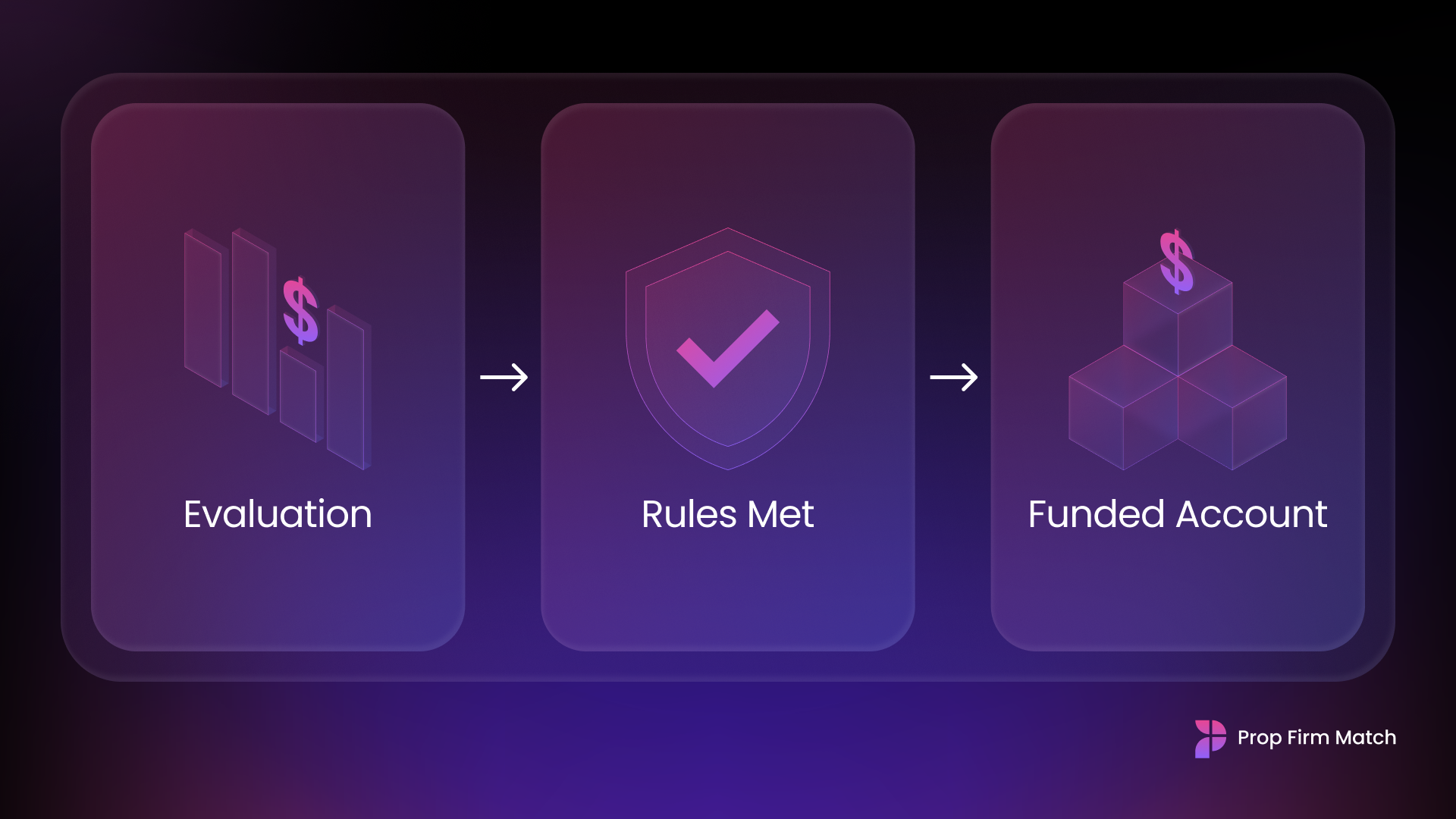
- The trader attempts an evaluation or challenge
- The trader proves profitability under strict risk rules
- The firm grants a funded account
- Profits are shared between the trader and the firm, referred to as the profit split
This structure allows prop firms to identify disciplined traders while giving traders access to capital they may not otherwise have.
Step 1 – The Evaluation or Challenge Phase
The evaluation phase is the first and most critical step in funded trading. During this phase, traders must reach a predefined profit target while staying within strict risk limits.
Common evaluation rules include:
- A profit target (often between 8% and 10%)
- A maximum daily drawdown
- A maximum overall drawdown
- A minimum number of trading days
- Restrictions on high-risk behavior
The goal of the evaluation is not aggressive profit-making, but consistency and risk control. Most traders fail this stage due to overtrading, emotional decision-making, or ignoring drawdown limits.
Step 2 – Verification Phase (Why Some Firms Require It)
Some prop firms include a verification phase after the initial challenge. This phase usually involves:
- A lower profit target
- The same or slightly stricter risk rules
- A stronger emphasis on consistency
The purpose of verification is to confirm that a trader’s performance was not driven by luck or excessive risk. Traders who pass this phase demonstrate repeatable behavior, which is why firms are more confident offering funded accounts afterward.
Not all firms require a verification phase, but those that do often prioritize long-term consistency over fast results.
Step 3 – The Funded Account Phase
Once a trader passes all required stages, they receive a funded trader account. This is the stage where traders become eligible for payouts.
Key differences in the funded phase include:
- No fixed profit target
- Profit splits apply (commonly between 70% and 90%)
- Payout cycles begin
- Scaling opportunities may become available
Although traders are now funded, rules are still enforced. Exceeding drawdowns or violating trading restrictions can still result in account termination.
How Profit Splits and Payouts Work
In a funded trader account, profits are shared between the trader and the firm. The profit split depends on the firm and may increase as traders demonstrate consistency.
Typical payout mechanics include:
- Payout eligibility after meeting minimum trading-day requirements
- Weekly, bi-weekly, or monthly payout cycles
- Withdrawal methods such as bank transfer, crypto, or payment platforms
Understanding payout rules is essential, as many traders misunderstand when and how profits can be withdrawn.
Scaling Plans – How Funded Accounts Grow Over Time
Many funded trader accounts include scaling plans that increase account size as traders perform consistently. Scaling is designed to reward discipline rather than aggressive growth.
Common scaling requirements include:
- Achieving a specific profit percentage
- Maintaining drawdown discipline over multiple payout cycles
- Avoiding rule violations
Over time, scaling allows traders to manage significantly larger capital allocations.
What Happens If a Trader Breaks the Rules?
Rule violations are handled differently depending on severity. Minor breaches may result in warnings or account reductions, while serious violations usually lead to immediate termination.
Common reasons funded accounts are lost include:
- Exceeding daily drawdown limits
- Overleveraging positions
- Trading during restricted news events
- Using prohibited strategies
Understanding these risks helps traders approach funded trading with realistic expectations.
Case Study – A Typical Funded Trader Journey (Example)
James is a trader who joins a funded trading program with a $50,000 evaluation account.
- Weeks 1–2: James focuses on controlled, low-risk setups and avoids overtrading
- Week 3: He reaches the profit target without exceeding daily or overall drawdown limits
- Verification phase: James repeats similar performance with slightly reduced risk
- Funded phase: He receives a funded account with an 80% profit split
- First payout: Profits are withdrawn after meeting the program’s payout conditions
- Scaling: After several consistent payouts, the account size increases
This is a simplified example meant to illustrate the process rather than guarantee outcomes. It highlights how funded trading rewards patience and discipline over aggressive strategies.
Who Funded Trader Accounts Are Best For
Funded trader accounts are best suited for:
- Traders with consistent strategies
- Traders who respect strict risk rules
- Traders seeking capital access without personal financial risk
They may not suit traders who prefer unrestricted trading or high-risk approaches.
How Funded Trader Accounts Compare to Trading Your Own Money
For beginners, the main difference between funded trading and trading personal capital comes down to risk exposure and structure. Funded trader accounts allow beginners to trade using firm-provided capital after passing an evaluation, which limits personal financial risk to the evaluation fee. Losses are capped by clear drawdown rules, helping newer traders avoid large, unrecoverable losses early in their trading journey.
Trading your own money gives full control over decisions, but all losses directly affect personal savings. For beginners still learning risk management, this can increase emotional pressure and make mistakes more costly. As a result, funded trading often appeals to beginners who want a structured environment with defined rules, while personal trading may be better suited once discipline and consistency are well established.
To explore this comparison in more depth, including costs, psychology, and long-term growth, traders can read the full guide here:
Where to Go Next
If you understand how funded trader accounts work, the next step is choosing a challenge or evaluation that matches your trading style, preferred markets, and risk tolerance.
Rather than relying on marketing claims, Prop Firm Match helps traders compare challenges and evaluations side by side, including rules, pricing, payout structures, and real trader reviews, so you can make an informed decision before paying any fees.
From here, you can explore:
- Prop firm challenges and evaluations based on verified trader reviews
- Challenges and evaluations by asset class, including forex and futures evaluations
- Challenge and evaluation rules, such as profit targets, drawdown limits, and payout structures across firms
→ Compare prop firm challenges and evaluations on PropFirmMatch
Frequently Asked Questions About Funded Trader Accounts
How long does it take to get a funded trader account?
The timeline depends on the firm and the trader’s performance. Some traders pass evaluations in days, while others take weeks. Programs with verification phases typically take longer.
Do funded trader accounts use real money?
Some firms use live capital, while others use simulated accounts with real payouts. In both cases, traders receive real profit withdrawals if they follow the rules.
From a trader’s perspective, the trading experience is largely the same, as payouts and performance requirements remain tied to real outcomes.
Can you lose money with a funded trader account?
Personal trading capital is not at risk beyond evaluation or reset fees. However, breaking rules can result in account termination.
This means the primary financial risk is limited, but time, effort, and evaluation fees should still be considered before joining a program.
Why do most traders fail funded challenges?
Most failures are caused by overtrading, emotional decisions, or poor risk management rather than strategy issues.
Many traders also underestimate how strict drawdown rules can be, especially during periods of market volatility.
Are funded trader accounts suitable for beginners?
They can be, provided beginners take time to understand drawdowns and risk limits. Smaller accounts are often a better starting point.
Beginners who treat funded trading as a learning process rather than a quick profit opportunity tend to perform better over time.
Can you trade news or hold trades overnight?
This depends on the firm and account type. Some allow it under conditions, while others restrict it entirely.
Rules can differ between evaluation and funded stages, so it’s important to review each firm’s news trading policy before trading around major news events.
What happens after consistent payouts?
Many firms offer scaling plans that increase account size as long as the trader maintains discipline and consistency.
Scaling is usually gradual and tied to multiple successful payout cycles rather than a single strong performance.
Related Articles
Keep Reading

YLOS Trading at Prop Firm Expo London 2026: What Traders Should Know
YLOS Trading puts payouts at the centre of its futures funding model, offering four plans, fast withdrawal processing, and 100% of the first $15,000 in trader profits before the standard split applies. This guide explains how the plans, drawdown models, payout rules, and news restrictions work, and what traders should ask at Prop Firm Expo London 2026.
Jun 23, 2026 • 5 min read
1
Chart Academy at Prop Firm Expo London 2026: What Attendees Should Know
Chart Academy is a pre-launch trading education platform built around free masterclasses, personalised learning paths, and trader rewards. This guide explains how the model works, what attendees should understand, and what to ask at Prop Firm Expo London 2026.
Jun 23, 2026 • 7 min read

WealthCharts at Prop Firm Expo London 2026: What Traders Should Know
WealthCharts is sponsoring the Trading Competition at Prop Firm Expo London 2026, giving traders a live way to test its multi-asset charting, scanning, AI, and prop-account tools. This guide explains what the platform offers, which prop firms support it, and what traders should ask at the Expo.
Jun 23, 2026 • 8 min read

Reviews & Rankings
News & Insights
Tools & Resources
Programs & Rewards
200 Loyalty Points Welcome Bonus.
Sign up free to claim points, unlock rewards, save favorite firms, and start earning more through reviews and platform activity.



